Shortly after returning to Georgetown, and while actively engaged in the arrangements for getting married, I received a most disappointing letter from Bookers Shipping Department who were the agents for Canadian National Steamships, owners of the Lady Boats.
As previously stated, I had booked passages to sail on this line to Canada, and the information
I received was to the effect that I would only be allowed to proceed there on condition that I would be taking up agriculture, and that I was required to have a capital of not less than one thousand dollars (Canadian). This was, unfortunately 1930, the year of the great depression, and Canada had high unemployment. As a result, restricting immigration to special occupations was a protective measure to help the economy.
This news came as a great shock to us, but I decided to go ahead and get married anyway. This called for a revision of all our well- made plans, and it was agreed that after the wedding, Emma would continue with her job at C.A. Phillips & Co. and I would go to Trinidad and try to obtain employment at W.C. Ross & Co. which was a large pharmacy owned by Bookers of British Guiana, my erstwhile employers.
And so, on September 18th 1930, Emma and I were married at a quiet morning ceremony in St. Andrews Presbyterian Church by Rev. Leslie, the Moderator.


The bride was given in marriage by Frank Drayton, an old friend of her family, for like myself, both her parents had passed on. My best man was Bolton Applewaite, a son of my guardian during my teenage years. After the reception, we motored up the east coast and spent four days at the Belfield Hotel’s “honeymoon” suite.
On the 5th day after our marriage, I sailed for Port-of-Spain, Trinidad, leaving on one of the Lady boats. Emma remained in Georgetown, putting up at the home of Mildred Mansfield until such time as I could stabilize my position and send for her to join me. It was late afternoon on the following day that my ship pulled into Port-of-Spain harbour, and after very brief customs formalities, (there was very little of this in 1930) I decided to spend my first night in the Miranda Hotel, a fairly unpretentious place quite close to the shipping area.
The trip from Georgetown took thirty six hours, and it was uneventful, at least for me. This was the first time I had been abroad, and perhaps under normal circumstances, I would have been quite thrilled. Unfortunately, I could not help thinking of our disappointment in not being able to go to Canada, of what the future held in store for us, and last, but by no means least, of the girl I left behind……
Before I was out of bed next morning - my first morning in Trinidad - my brother Jack, whom you will recall had migrated there several years ago, and who had learnt of my arrival from a newspaper report, came over to the hotel and invited me to stay at his home in the city. And so, once again, after an absence of about sixteen years, my eldest brother came back into my life. I had lost all contact of Jack & his wife for quite a long time, so that his invitation to live with him was very welcome.
Packing up my things I left the hotel, and went along with my brothers to his home in Abercrombie Street. Here I met Maggie, his wife, and I was given a room for myself. The house was comfortable and reasonably large, with a lot of space towards the back.
Jack had got on rather well, and at this time he was government shorthand writer for the legislative council in Trinidad. He had a cruising speed of 240 words per minute in the Pitman system, and his job was considered quite good. He had a large and well appointed office at the Red House, and his workplace was within walking distance of his home.
After I had settled down a bit, I went to interview W. Webster manager of W.C. Ross & Co. in Frederick Street. Mr. Webster was a Scot and was previously manager’s assistant of the British Guiana’s Bookers Drug Store during the time I was employed there. He therefore knew me quite well and was glad to offer me a job, even though it was only a small bit, assisting in the production of Bay Rum, a toilet lotion, and also in the goods receiving department.
During my previous experience in pharmacy, I had taken and passed the intermediate examination for Pharmacists so I accepted this little job and concentrated on my studies at home, intending to take my final exams in Trinidad and thus become fully qualified. Both British Guiana and Trinidad were at this time British possessions, and there was reciprocity in respect of qualifications and examination requirements.

But fate decided that I should return to the country of my birth, and this is how it happened:- About five months after my arrival in Trinidad, there was a disastrous fire in Georgetown which resulted in the death of Cecil Cregan. He was employed as chief clerk at Bookers. Drug Stores there, and was a good friend and former colleague of mine. He was burnt to death in the conflagration. Following the vacancy which arose as a result of this, Emma made an appointment with J.A. Adamson, manager of Bookers Drugs, and asked that I be considered to fill one of the positions which were bound to occur. With my background of work, Adamson readily agreed, and I was recalled to Georgetown to fill the position of Customs Clerk.
This was early in 1931 when I returned to my old home town, and Emma and I went to live at Mrs. Bryce’s boarding house in Robb Street.
The customs work I was given was quite new to me, but I pitched into it even though it involved a lot of running around in all sorts of weather, in and out of hot warehouses and bonds. Coming back to the office after several hours of outdoor work, I had to do quite a bit of clerical work, and in an effort to master the job in the shortest possible time I probably overdid it. After just one month in the new occupation, I contracted Influenza, and instead of taking time off and recuperating fully, I simply continued to work as usual. As a result, my condition worsened, and before long the firm’s doctor ordered me to hospital, since pains developed in the region of my chest. The condition was diagnosed as Emphysema. At this point in time, Alexander Fleming had not discovered Penicillin, nor were the Sulpha drugs developed. By modern standards I was given very primitive treatment, and I do remember drinking vast quantities of Parke Davis’ Palatol and Creosote with Guiacol.
In the end I had to have rib resection, after which a tube was inserted into the pleural cavity, and the area drained. In spite of it all I survived. Dr. George Mearns performed the operation. Leaving hospital, I spent a full month recuperating at the home of Emma’s sister, Dorothy, at Springlands on the Courantyne coast near to the border of Dutch Guiana. Dorothy was the wife of Dr. Jabez Taitt, who was as I recounted earlier in this autobiography, the medical officer stationed at H.M.P.S. during my boyhood days there. He was now serving as G.M.O. in this country district of Springlands.
Returning to work after my convalescence I was given less strenuous indoor occupation, and gradually regained my health.
Our first little home was a rented two-bedroom house in lower Charlotte St. and on Xmas day 1931 Gordon, our first child, was born. I remember preparing our Xmas dinner that day, roasting the chicken all by myself, Emma being too anxious to do much in that respect at the time.
Six to eight months later, we removed into a neat little cottage in Light Street. This place was owned by my firm, Bookers, so it was more or less reserved for employees.
This home will always be associated with several important aspects of my life, for while living here I qualified as a pharmacist in 1933. It was also while living here that I was given the Management of Bookers Bourda Pharmacy, one of my firms many branch stores, and here also was born our second son, Michael. By a remarkable chain of circumstances, this very house and a smaller one next door, in addition to the pharmacy which was located at the corner of Regent and Light Streets, were all purchased by me just twenty years later, and successfully operated as Gilkes’ Bourda Pharmacy for seven years before I sold out and went to England to take up residence there. My son, Michael, who was born in this house, also had the distinction of lifting his bride over the threshold when he occupied it as his home after returning from his honeymoon.
Having taken and passed my Final pharmacy exam in 1933, I was now a registered pharmacist, and was promptly appointed to the management of my firm’s Bourda branch. We moved over to the apartment located above the business, and I settled down to my first real job of serious pharmacy.
During the five years I spent there, the building was enlarged to almost twice its size, both the apartment above and the shop below. There was also some modifications in the cottages next door. Our elder son Gordon, started out to school while at this location, attending Cicely Pilgrim’s “Montessori” establishment in Carmichael Street. I can clearly recall the many sleepless nights both Emma and I spent during a spell when both boys, then aged about three and five years, contracted whooping cough, which lasted for quite a long time. The finest medicine was a syrupy liquid called “Pertussin” What a contrast to the present mode of immunizing against, not only whooping cough, but diphtheria and tetanus as well, with a single injection of D.P.T.
One of my achievements while managing this branch, was winning a free, two-week trip to one of the Caribbean Islands. This was an offer my firm made to its branch managers who reached a certain sales level for Ferrol, a cod-liver oil extract & iron preparation, which it manufactured. Having won, I naturally chose to go to Trinidad, and was able to take Emma along. We lived at the home of my brother Jack, who had moved up the ladder of success quite a bit, and owned a delightful home in the select residential district of St. Clair. We did a lot of sightseeing in his new Pontiac, visiting many of the beauty spots on the island, such as the Blue Basin, Mayaro and Manzanilla beaches, and the Nursery at St. Augustine. We also took in the magnificent views from the tops of such heights as Lady Chancellors, Fort St. George and Mount St. Benedict.

After about five years at Bourda Pharmacy, I was promoted to my firm’s largest branch, in New Amsterdam, Berbice. New Amsterdam is a little town situated near to the mouth of the Berbice river. It was the next largest town after Georgetown, the capital city, and served as a supply centre for the several and large sugar plantations on the Courantyne coast. Almost all of these sugar estates were owned by Bookers, so it was quite important to hove a large supply depot in New Amsterdam. Apart from catering to the needs of the population of this little town, I had to keep the hospitals of the sugar estates fully supplied with drugs and medicines, and since this area contained the largest and most of the sugar plantations Bookers owned, there was quite a lot of work involved in operating this branch.
Some of the names of these sugar estates were quite unique, such as “Port Mourant”, “Skeldon”, “Albion” and “Rose Hall, Canje”. This branch also carried a comprehensive stock of groceries, and also the largest refrigerator I have ever seen. The estates purchased most of their food requirements from us, but this section was taken care of by a colleague, Arthur Fryer, who was a grocery-trained man.
Here was a great big rambling building with the business below, and my living quarters on two floors above it. There was so much space in the flats above that our furniture was almost lost there. Of the four large bedrooms, we started by using only two. Later on we allocated one of the others to our domestic help, who lived in, and we afterwards fitted up the last one as a guest moon. There were so many windows in the house, that when rain started to fall, and we began closing them, before we could complete the closing phase, the rain very often had stopped!
Our daughter Maureen was born in New Amsterdam, and she was a welcome addition to her two brothers. It was really lucky for us that a large Catholic school of the elementary type was located obliquely opposite, across the road at the corner of Main and New Streets, so it was a simple matter to enrol the boys there. The name of the headmaster was Crawford.
It did not take me long to realize that in the interest of progress, extensive renovation and rebuilding would have to be done to this structure, and so plans were drawn up, and a brand new two storied warehouse was built at the rear of the lot, and substantial alterations made to the existing building. It seemed that whichever branch I managed had to have extensive repairs done, which of course created a hardship while the work was in progress. During my four years tenure at this job, there were several incidents that stand out in my memory. One was a historic bicycle ride with a friend, Cyril Grant, forty miles along the Courantyne road to a health resort called No. 63 Beach, and back home the same evening, making a total of 00 miles covered for the road trip. I even turned out to play field hockey the following afternoon, whereas my companion Cyril, who was 10 years younger then I, was too sore to attend.
Another incident was when Gordon, our first-born, fell off the balcony of our house, which overhung the street, fracturing both bones in his left forearm, and one in the other. He had to be picked up from the street, rushed to hospital, have the fractures set and finished up with both arms in slings.
New Amsterdam, and indeed, the greater part of the county of Berbice, was notorious for its mosquito infestation, and swarms of these insects would make life almost intolerable after dark, Fortunately for us residents of the town, however, our mosquitoes were the salt-marsh type, neither Anopheles nor Culex, so they were really more of a nuisance than a health hazard.
T here was also that memorable trip Emma and I took to the great Kaiteur Falls during our life in Berbice. We journeyed to this wonder of nature with a party of about thirty from Georgetown, and travelled to this marvellous waterfall on the Potaro river, going along the overland route. It required a whole weeks travel, first by train, then by river steamer to Bartica, then by covered truck through one hundred and one miles of virgin forest, then by small open boats to a point called Tukeit just below the escarpment leading to the falls. We finally climbed this steep ascent for roughly one hour in order to reach to the top of this glorious wonder of nature.
On the way we passed lots of interesting places end sights, stopping and spending a couple of nights at pre-arranged rest houses, one of which, built near to the Denham Bridge and overlooking Garraway Stream, commanded a never to be forgotten view of river and forest scenery. The sight of Kaiteur was truly majestic and awe-inspiring. I climbed to the edge of a cliff and looked down upon this mighty river, cascading from one level for 741 perpendicular feet to another level below, before continuing for another couple of hundred feet in a sloping descent, until it reached its lower level about a thousand feet from the spot where I was viewing all this. Looking at the spume as the water tumbled over the edge in its drop straight down, I had to wait for several seconds to adjust my vision to the fantastic picture below. Suddenly the entire gorge would be enveloped in a sheet of white mist, then it would as quickly disappear, and I could see the beautiful ferns and tropical foliage on the rocky wall behind the falling water.

Without warning, three or four rainbows would appear in all their splendour, no doubt produced by the rays of the sun shining down upon the whole scene. Then everything would cloud up again, and keep on changing appearance time after time it was truly magical. The roar of the falling water was like the deep-throated sound of a giant orchestra way in the distance.
We stayed atop Kaiteur for the greater part of that day, drinking in all we could of its unspoilt and natural beauty, returning to our base camp at the foot of the escarpment after a rather tricky descent. On many occasions we had to cling to snail shrubs and branches of trees to avoid accident. It was, in my opinion, the best way to see this waterfall. Nowadays, people go there by plane, landing on the river just above the falls, missing all the thrills and fun that we had.
An attempt to introduce and foster outdoor sports to my Berbice staff was made when I got permission from the governing body of the Wesleyan Church next door to our building, to use a vacant lot of land at the back of their church. I requested and got support, financially, from my firms head office in Georgetown as well as from other well-wishers, and proceeded to put the land in condition for playing both tennis and volley ball. Several months were spent putting in subsoil drainage, filling and levelling spots, and rolling and mowing the surface. T.S. Harrington, who was in charge of the Pure Water Supply in New Amsterdam and a friend of my branch, donated the fixtures for the tennis and volley ball courts, and so we began to use the ground. At the start the staff was very enthusiastic, and at one time we had competitions, teams from other local clubs taking port. On one occasion, a team of volleyball players, captained by my younger brother Frankie, came all the way from Georgetown to do battle with us.
After a couple of years however, interest in sport seemed to wane, and it came to an almost dead stop by the end of the fourth year, when I was once again transferred on promotion from Berbice back to our head store in Georgetown, at the corner of Main and Church Streets.
World War Two had started while I was stationed in New Amsterdam, and strict price control of everything imported was imposed by Government. I was therefore given the responsibility of fixing these prices, and since any price in excess of the profit margin allowed by government was a serious offence, punishable by heavy fines and dire consequences - it was quite a job.

I was also given supervisory control of the wholesale department, which not only supplied all stocks to the eight branches the firm then operated, but dealt with many of the other independent drug businesses as well, in addition to supplying the other sugar plantations in the county of Demerara. The second world war years were difficult ones for a young family such as mine. Shortages occurred not only in foodstuffs, but also in commodities like bicycle tubes and tires, and many household necessities. The streets of Georgetown were flat, no hills, so cycling was a very popular method of transport.
During this period, blackouts were enforced, and I, in company with other staff members joined the local equivalent of the British Home Guard in which I was appointed a Fire Warden. Training was provided by the Georgetown fire Brigade, and after we were deemed sufficiently competent, we were taken out with the regular fire-fighters for active work during their practice sessions.

1945 will always be remembered as a black year for Bookers. It was the year of a disastrous fire which ravaged the business heart of the city. So far reaching was its effect that both Banks, Barclays and Royal Bank of Canada declared a moratorium in order to sort things out. Also destroyed by this fire was the government savings department of the general post office, where a great number of the ordinary man-in-street kept his savings.

The trouble started at Bookers Drug Stores, yes - the place where I worked, and what is more, the fire began on the floor immediately above my desk. At that time my firm manufactured a product called “Limacol”, which is a toilet lotion containing alcohol. Incidentally, this product is still made by them, but in a strictly rural area, away from the city. Allegedly the conflagration was caused when a large quantity of alcohol, which was about to be converted into Limacol became ignited. It came out in an enquiry afterwards that a workman was using a blow-torch in the vicinity of the alcohol vapour which set the place alight. One of the firms’ employees, a young man named Morris was burnt to death, and in no time at all, the entire huge building was ablaze.
From the nature of the stock held, it was difficult to control the blaze, as all sorts of very inflammable items were stored and sold from this huge business. With a head start such as this, and with the aid of an adverse wind, in a very short time, the fire had spread to several large businesses in this the very heart of the down-town area. There was little that I could do personally, so I jumped on my bicycle and rode dazedly home….
There were many hardships for us, the staff, following this fire, and after a couple of temporary locations, in which we tried to reorganize ourselves, we finally arose, like the Phoenix from the ashes, to even greater strength than before.
We had removed once again, to a three-bedroom house in upper South Road, directly opposite to Queens’ College across an open field. Our two sons, Gordon and Michael had been attending the Government School in Broad Street since our return from Berbice, and it was from this Broad Street School that Gordon qualified for a place at Queens’ College, after taking an annual examination for this purpose.
With his brother now a pupil of the best school in the country, we enrolled Michael in the preparatory division of the same college, thus ensuring his entry there at a later date. A couple of years after his admission to Queens’ College, Michael was successful in gaining a middle school scholarship, which provided him with free tuition at this seminary for several years, taking him right through college at no further expense to his parents.
While living at this South Road home, I recall taking my two sons, Gordon and Michael as well as Leslie Melville, one of their college chums and a good friend of our family on a weekend tour of the area where I spent some of my boyhood years. We visited H.M.P.S. Bartica, Cartabo Point, and the ruins of the old Dutch forts at both fort Island and Kyk-Over-All. We joined the early steamer in Georgetown, and travelled out into the Atlantic Ocean along the coastline, entering the Essequebo River at Parika.
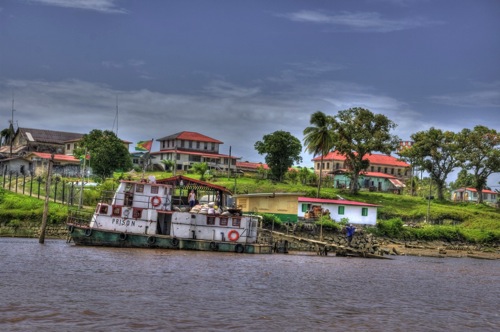
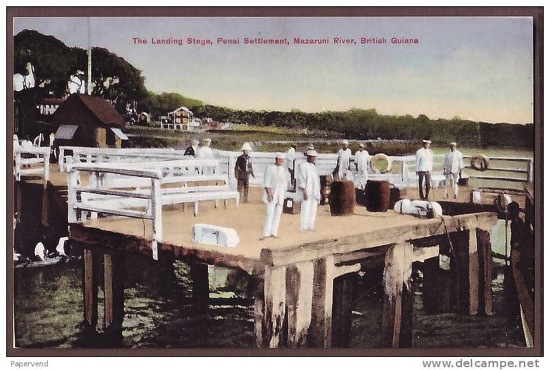
Continuing from Parika we stopped for a short while at fort Island (a former Dutch fortified area) then proceeded up river for three or four hours arriving at Bartica (the terminus) late in the afternoon. We had booked sleeping accommodation on the ship, but on the following morning we rented an outboard motorboat and toured the Mazaruni river, stopping at H.M.P.S., where I lived as a boy for five years.
We afterwards visited Cartabo Point and Kyk-Over-All, where we inspected this tiny island, which at one time in the history of this region, provided such useful fortifications for the Dutch who then occupied the country. We inspected the stone and brickwork erected by those early settlers and noticed that some of the archways were still in a state of fairly good preservation. It was both an educational and a pleasure trip, and the boys thoroughly enjoyed it.
Maureen, our older daughter, started school at this point, and became a day pupil of St. Roses Ursuline Convent. Our second daughter and last child, Marsha, was born while we lived here, but in the interest of health we changed our residence and went to live at the corner of North Road and Oronoque Streets. We did not spend too much time in this North Road place. It was, unfortunately, an apartment, with another one above, and to say the least, we did not have the type of neighbour in the upper apartment who would make life in the lower level even just bearable.
During our residence here a rather serious accident happened to Gordon. He was kicked by a prancing racehorse called Swiss Roll owned by the Lams’ and after a court action which resulted, we received damages money in settlement of the case. The injury was to Gordon’s knee, and we sent him on a little holiday to his uncle Jack in Trinidad to recuperate during the summer vacation.
Having changed rented houses so many times over the last ten years, we were becoming tired of these frequent removals. We therefore decided to buy a place of our own, and with a great deal of help from my employers, Bookers, we purchased our first home in a residential area in Queenstown, at the corner of Almond and Oronoque Streets.
The acquisition of this property was one of the major steps in my life. It was a nice little home with three bedrooms, and was set well back from the road. There was plenty of yard room on bath sides of the house, and quite a number of fruit trees such as Genips, Mangoes, Downs, Cherries, Bananas, Limes, and even three full-grown Coconut trees, all bearing fruit and nuts. It was really a great adventure for me, and without delay I started to have work done on the property to improve it. The kitchen was remodelled, the zinc corrugated roof painted with anti-corrosive, window awnings erected, and bathroom improved. Lastly, I undertook the colossal task of raising the level of the yard about one foot.
The property next to ours was built on somewhat higher ground, and in the rainy season the accumulated storm water would drain on to our land causing it to flood. Fortunately, at that time, the City Water Commissioners were putting in a new water purification plant, and a large area within half a mile of us was being excavated for the erection of a sedimentation system. I arranged to have well over a hundred truckloads of earth brought into our yard, the only cost to me being that of transportation.
After the earth was spread over the whole area of the yard, I then put on a layer of crushed sea-shells which produced a really nice finish. As if this were not enough, I then proceeded to do a lot of cement work on the front entrance leading to the gate, and to most of the space below the house.
I had to admit that I really overdid things, doing too much, too quickly. Added to this was the financial strain involved, and before I knew it, I had developed the characteristic pains of peptic ulcer. My firm’s doctor requested X-Rays, and a duodenal ulcer was disclosed, so I was ordered to St. Joseph’s Mercy hospital for rest and treatment. I spent one whole month there and the doctor, S. Bettencourt-Gomes was really good to me. My employers were also magnanimous, they paid all expenses, without its affecting my usual salary. Upon my return home from hospital, I had to take life a lot easier, and was able to enjoy many happy years in our little home.
One of the privileges that senior employees of Bookers enjoyed, was a three to four month vacation every four years. Round trip passage to the Caribbean islands was also paid, in addition to an advance of your full salary for the period of your vacation. As luck would have it, my turn came around a few months after my hospitalization, and I was thus able to make good use of it. We leased our furnished home to a friend of ours, Seton Olton and his family for four months, boarded out our two boys and Maureen at the Taitt's, while Olga and Hilbert Holder, two of our best friends kept Marsha at their home.
Emma and I then took off on holiday, visiting Trinidad, Barbados, St. Vincent and Antigua. We spent about two or three weeks with my brother Jack in Trinidad, and then flew over to St. Johns, capital of Antigua spending one month there with Foster & Sybil McDonald. It was our first visit to Antigua, and we thoroughly enjoyed this lovely windswept little island and its friendly people. The sea-bathing here was superb, and I recall one of the beaches we swam at called Half-moon bay, which had the shape of a very wide crescent, with surf-bathing on one side, and calm, glass-like sea on the other arm of the inlet. I also enjoyed a lot of tennis during our stay here.
In the days of the buccaneering pirates, when the kind of people like Henry Morgan roamed the Caribbean waiting to prey on Spanish shins passing by, the island of Antigua played an important part in helping to achieve this end. Lord Nelson, that outstanding British sea-dog used the natural deep water and concealed harbours of this island to hide his ships in, before sallying forth to do battle with the enemy and so help to place Britain in the position of a leading sea-power. To this day, English Harbour and Nelsons Dockyard remain in a state of partial preservation to the memory of this famous Admiral who played such an important role in the British Navy of his day.
Emma and I visited both of these relics of past years, and we were shown over the remains of “English Harbour” where the ships docked, and we also had the pleasure of visiting Nelson’s quarters. The wooden bed in which he slept is fairly well preserved, and we couldn’t help thinking back on those rather robust times as we gently touched the rails protecting it. When we tried to collect the sea anemones below the surface of the water of Nelson’s Dockyard, they would simply fold up as if in resentment of our approach.
Another memorable evening spent while in Antigua was at the Beach Hotel, where we were guests at a delightful dinner there. This hotel was built like a huge ship, complete with windows shaped like portholes. There was afterwards a party on the lawn, and the hotel being built near the sea, the lawn was on a cliff which overlooked the water.
After a really jolly month spent on this beautiful island, we flew into Barbados, and put up at the Mandeville’s who were the people with whom Gordon lived during his training there as a cable & wireless operator. (Incidentally, he was now employed at Cable & Wireless, Georgetown, as a fully fledged operator). In Barbados, we sea-bathed frequently, and took in most of the sights.
Although a very small island, it is truly wonderful, with very friendly people.
Barbados is usually referred to as Little England, and there are many reminders of the Mother country in the names of several of its places and monuments. There is even a Trafalgar Square.
When I was a boy at school, I recall my schoolmaster telling me that during the period of English history when Oliver Cromwell was Lord Protector, he would rid the country of recalcitrant persons by saying to them “I’ll Barbados you!” He would them proceed to banish them to this little island in the Caribbean, and no doubt, for this reason, a strong flavour of English life and custom is now present there.
Leaving Barbados we visited St. Vincent, another of the Windward Islands. We spent a short time in its capital, Kingstown, and then we rented a delightful bungalow at a sheltered resort called “Villa”. Villa was separated from a high rocky promontory called Young‘s Island by a calm body of delightfully blue water which was really a swimmer’s paradise. Our bungalow was right on the water’s edge, and we often took boat rides in small craft over to Young’s Island.
Before we left “Villa”, we joined a party, and partly drove and partly walked up to the summit of the “Soufriere”, an extinct volcano, and having reached the edge of the crater, we looked down into the lake way down below. To give some idea of how far down this crater lake was from the edge of the lip, we tossed rocks into the lake, but the rocks would disappear from sight before we could see them strike the surface.
From St. Vincent, we flew over to Trinidad on the last leg of our journey back home. We still had a few weeks of our vacation left, and spent viewing more of the scenery of this lush island, its oil fields, pitch lake, and lastly, attending the famous “Carnival” celebrations which is one of the high points of life in Port-of-Spain.
We sailed for home after a truly glorious vacation leaving Trinidad by shim, called the Alcoa Pegasus. After that disastrous fire which my firm sustained in 1945, the drug department was, we thought, permanently located in Water Street in new premises purchased, between Resaul Maraj on one side, and Fereira & Comes on the other. Everything as going well, and the firm was now almost back on its feet again, when, horror of horrors, Resaul Maraj’s business on its left, caught afire, and once again Bookers Drug Store was razed to the ground. Fortunately at that time, a huge stone and steel complex called Bookers Universal Store was just about completed and constructed on the site of the original l945 fire, and the Drug department was re-opened on a smaller scale into a section of it. At this point also, there was fission of the department into (a). a retail outlet and (b) a wholesale and manufacturing depot. The retail department was, as stated, occupying a portion of the Universal store, and I was appointed Manager of it. The manufacturing end was located at La Penitence, which is on the fringe of the city of Georgetown.
The opportunity was also taken to make a fresh start by revolutionizing the entire concept of retail drug merchandising, and to this end, the services of a Specialist from Boots the Chemists of England were engaged. The name of this man was Denver Williams and he proved to be a great help to me personally in the years to come.
My energies were now fully absorbed in my new job, and I sold our Oronoque and Almond Street home, making a profit on it which enabled me to liquidate all my debts, and provide what was my first “nest egg” in the form of a bank balance. This was to come in very handy in a very short time.
We then rented a two-storied house in Church St. and lived there. It was near to the corner of Cummings Street, and the Lamaha Canal ran right in front of the building. I also invested in our first automobile, a brand new Morris Oxford. During one of the annual visits of Jock Campbell, the London, England Chairman of Booker Brothers, my employers, it was decided by the Board of Directors to dispose of several of their branch stores.

Being completely conversant with branch management, I decided to make a good try at acquiring the Bourda Pharmacy at the corner of Regent and Light Streets. I had managed this branch for several years, and knew its possibilities, its customers, and the general area quite well. The great snag was, where was I to get the money for its purchase? After thinking the matter over, I placed an overseas call to my brother Jack, in Trinidad, and he readily agreed to supply the funds necessary to buy the business. Following his telephone promise, he cabled me a cheque for twenty-two thousand dollars, and he and I entered into partnership and became owners of Gilkes Bourda Pharmacy.